My Greek Table by Diane Kochilas
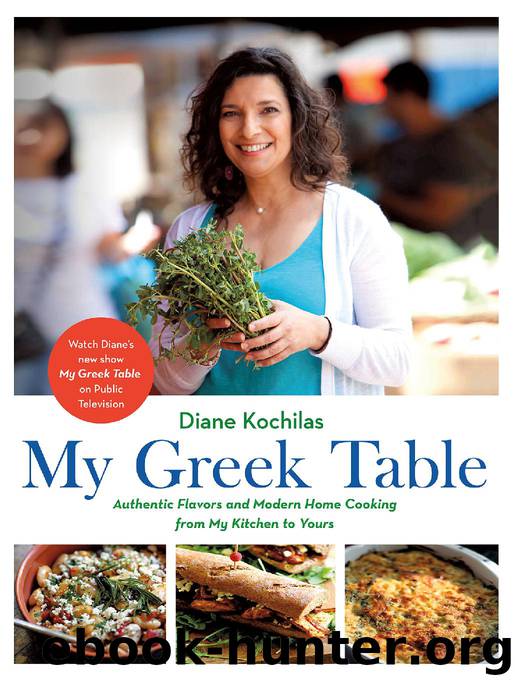
Author:Diane Kochilas [Kochilas, Diane]
Language: eng
Format: epub
Tags: gnv64
Publisher: St. Martin's Press
Published: 2018-11-13T00:00:00+00:00
Paximadia
TRADITIONAL CRETAN MIXED-GRAIN RUSKS
makes about 10 pounds (4.5 kg) rusks
Paximadia—rusks—have a long and storied history in Greece. Paximadia more or less as we know them today derive from the ancient Greek dipyros, which means “twice-baked,” and were essentially a savory biscuit. The rusks are called paximadia after a first-century-AD monk named Paximus, who improved on the ancient recipe, leaving a legacy that is a living tradition to this day. Rusks are made all over Greece and come in all manner of shapes and sizes; the dough can be made from wheat, rye, barley, corn, carob, or chickpea flour, or from various combinations thereof. This recipe is from a home baker in the town of Enagron, a mountain village between Rethymnon and Irakleion. Crete, perhaps more than anywhere else in Greece, is renowned for the variety of paximadia, both sweet and savory, traditionally made on the island.
2 pounds (900 g) whole wheat flour
2 pounds (900 g) all-purpose flour
2 pounds (900 g) cornmeal
2 pounds (900 g) rye flour
2 pounds (900 g) barley flour
1 pound (450 g) sourdough starter (called prozymi in Greek and made by keeping 1 pound / 450 g of dough from previous breadmaking; (see Note)
1½ quarts (1.5 L) lukewarm water
2 tablespoons sugar
2 cups (480 ml) extra-virgin Greek olive oil
3 tablespoons salt
18 lemon leaves, if you can get them
Download
This site does not store any files on its server. We only index and link to content provided by other sites. Please contact the content providers to delete copyright contents if any and email us, we'll remove relevant links or contents immediately.
Biscuits: A Savor the South Cookbook by Belinda Ellis(4346)
The French Women Don't Get Fat Cookbook by Mireille Guiliano(3671)
A Jewish Baker's Pastry Secrets: Recipes from a New York Baking Legend for Strudel, Stollen, Danishes, Puff Pastry, and More by George Greenstein(3611)
Ottolenghi Simple by Yotam Ottolenghi(3601)
Better Homes and Gardens New Cookbook by Better Homes & Gardens(3599)
Al Roker's Hassle-Free Holiday Cookbook by Al Roker(3536)
Trullo by Tim Siadatan(3435)
Bake with Anna Olson by Anna Olson(3410)
Hot Thai Kitchen by Pailin Chongchitnant(3401)
Panini by Carlo Middione(3347)
Nigella Bites (Nigella Collection) by Nigella Lawson(3243)
Momofuku by David Chang(3197)
Salt, Fat, Acid, Heat: Mastering the Elements of Good Cooking by Nosrat Samin(3157)
Modern French Pastry: Innovative Techniques, Tools and Design by Cheryl Wakerhauser(3149)
Classic by Mary Berry(3020)
Best of Jane Grigson by Jane Grigson(3008)
Tapas Revolution by Omar Allibhoy(2991)
Solo Food by Janneke Vreugdenhil(2982)
Ottolenghi - The Cookbook by Yotam Ottolenghi(2954)
